STANDARDIZATION
Defence standardization
in the Republic of Slovenia
Defence standardization in the Republic of Slovenia
Defence standardization in the Republic of Slovenia includes the organisation and procedures for the preparation, adoption, issuance, implementation and application of Slovenian Military Standards (hereinafter: SVS), national ratification of NATO standards, and participation in the development of NATO standardization documents that ensure effective operation and connectivity (interoperability) of the Ministry and the Slovenian Armed Forces within NATO and European Union structures. Standardization is also included in planning, development, equipping and public procurement. The field of defence standardization includes: operational, material and administrative standards.
SVS - Slovenian Military Standards
A Slovenian Military Standard is a document that defines general and repeatedly applicable rules, guidelines, instructions or characteristics of products, services or related processes within the Ministry, with the aim of achieving an optimal level of order in a given area.
Rules
Slovenian Military Standards and NATO standards are free documents, but they are not publicly accessible, and the provisions of general regulations governing the field of standardization do not apply to this area. Defence standardization procedures are prescribed by internal acts of the Ministry of Defence of the Republic of Slovenia, as well as NATO and EU acts.
The basic condition for organisations to obtain SVSs and NATO standards is the existence of a need-to-know based on a contractual relationship between the organisation and the Ministry of Defence. In the case of obtaining standardization documents that have a certain level of data classification, it is necessary to follow the procedures defined in the legal acts of the Republic of Slovenia, as well as NATO and the EU, governing the handling of classified information.
The Standardization Department (OS) of the Ministry of Defence, as the national body for defence standardization, is responsible for the mediation or distribution of documents in the field of defence standardization.
The interested organisation can obtain standards and information on obtaining standards on the basis of an application, which it submits to standard@mors.si.
Basic concepts
STANAG (Standardization Agreement) – Standardization Agreement
is an agreement between Alliance member states on the use or implementation of a specific standard or several standards in full or in part, with or without reservations, in order to meet the interoperability requirement.STANREC (Standardization Recomendation) – Standardization Recommendation
is a standardization document used exclusively in the field of material standardization, and its provisions are not related to interoperability and are not binding, but rather recommendations for use.Allied standard
is a document whose provisions are implemented by member states, NATO bodies and partner countries to the greatest extent possible. Standards may be developed in NATO or selected from among civil standards, national or multinational defence standards.Standard Related Document – A document related to a standard
is a NATO standardization document that facilitates the understanding and implementation of one or more Allied standards. It may also provide additional data and information that serve as supplements to standards and are frequently changed, such as national cataloguing data.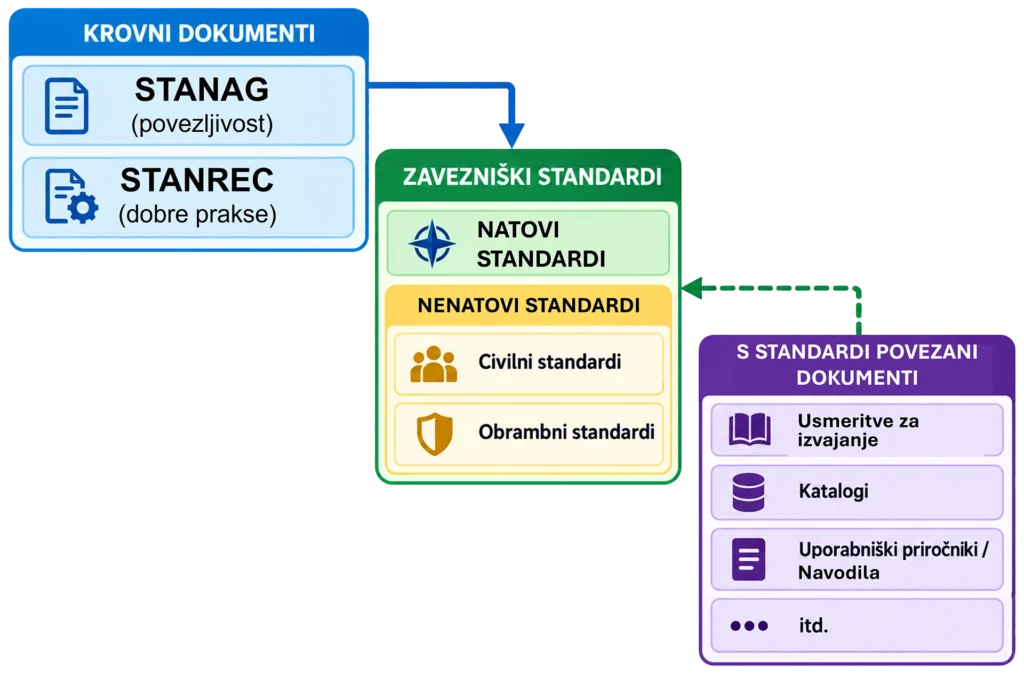
Contact
MINISTRY OF DEFENCE
Directorate for LogisticsResearch, Development and Procurement Sector
Standardization DepartmentVojkova 55a, 1000 Ljubljana
e-mail: standard@mors.si

LEARN MORE ABOUT STANDARDS
Standardization in NATO
NATO standardization includes the development and implementation of procedures, designs and terminology to a level that ensures the necessary interoperability between countries, or recommendations for best practices in international cooperation. It is a fundamental tool for achieving interoperability through a systematic approach that includes defining requirements, developing solutions, and their implementation and validation.
Interoperability in this context is the ability to work together in a coordinated, effective and efficient manner in order to achieve the tactical, operational and strategic objectives of the Alliance.
An Allied standard is a standard that has been developed or selected within NATO standardization processes. If the standard is related to interoperability requirements, it is published with a NATO Standardization Agreement (STANAG); if it relates to material standardization and is not related to interoperability requirements, it is published with a NATO Standardization Recommendation (STANREC).

NSO
The NATO Standardization Office (NSO – NATO Standardization Office) is a civil-military body responsible for supporting NATO standardization processes, the NATO Committee for Standardization in the field of standardization policy and management, and the Military Committee in the field of operational standardization.
NSDD
The NATO Standardization Database (NSDD – NATO Standardization Database) is an online database of all NATO documents created in the standards processing procedure. It provides access to the list of all published NATO standards and enables searching by titles, designations and keywords of standards.
Almost one third of the standards are publicly available and users can download them without restrictions; for other standards that have a certain level of classification or distribution restrictions, users can obtain access under certain conditions. In this case, they submit the completed application to the MORS Standardization Department (standard@mors.si).
CNAD
The Conference of National Armaments Directors (CNAD – Conference of National Armaments Directors) is a senior advisory committee that advises the North Atlantic Council on armaments matters. The Committee is responsible for promoting cooperation between countries in the field of armaments, thereby ensuring that NATO forces have the most modern and interoperable equipment.
With subordinate working groups, such as the Life Cycle Management Group, the Ammunition Safety Group and the Group of National Directors on Codification, it supports standardization and interoperability of Alliance capabilities and improves the effectiveness of NATO forces across the full spectrum of current and future operations.
DPC
The Digital Policy Committee (DPC – Digital Policy Committee) is a senior advisory committee in the field of NATO digital initiatives and consultation, command and control (C3).
It develops digital policy and provides guidance and advice to the North Atlantic Council and the Military Committee in areas such as C3, cyber defence, interoperability standards and profiles, and digital capabilities. It is composed of senior national representatives of Allied countries, representatives of NATO strategic commands, and other NATO committees and bodies concerned by its remit.
LEARN MORE ABOUT STANDARDS
Standardization in the EU
European Defence Standardization (European Defence Standardization – EDS) is a strategic tool for improving cooperation in the field of armaments and strengthening the European Defence Technological and Industrial Base, and a key factor for an efficient European defence equipment market. Ensuring a common position is a key element of European defence standardization and is of paramount importance. European defence standardization means the development and implementation of technologies, procedures, systems and design standards to achieve and maintain the required levels of compatibility, interchangeability or commonality in procedural, material and technical areas in order to achieve interoperability.
The main tasks are raising awareness of the benefits of standards, selecting best practice standards, and encouraging the development of hybrid standards. It also supports the creation of a standards database in line with the needs of the EU defence sector and ensures a uniform approach to the implementation and monitoring of stakeholders’ standardization activities at EU level. An important activity is also operating at global level by promoting the European Defence vision and cooperating in the field of standardization activities.
EDSTAR
EDSTAR = European Defence Standards Reference System. It is a database of best practice standards for defence purposes (BPS – Best Practice Standards). It is intended for project managers and experts in the field of defence and security when drafting technical requirements for defence products, and for industry when designing new products for defence needs.
In this context, expert groups within the EDSTAR JMG select the most appropriate standards from the set of NATO standards, European civil standards, international standards or other standards recognised by the EU, and then publish them in the EDSTAR system.

EDA / EDSC
To implement the European Defence Standardization Strategy (EDSS), the European Defence Standardization Committee (EDSC) was established, which also acts as a link between innovation and standardization. The Committee supports and strengthens the implementation of the Common Security and Defence Policy and the European Technological and Industrial Base.
The Committee operates in a closed format for EDA Member States and European Commission bodies, and in an open format for countries and organisations that have an agreement with the EDA. In January 2021, the EDSC established a subordinate working group, the EDSMG (European Defence Standardization Management Group), which supports the EDSC in European Defence Standardization management tasks, the development, maintenance and implementation of policies, plans and recommendations, and the promotion of activities among European standardization stakeholders.
The EDSMG also develops, assesses and improves processes within European Defence Standardization, while ensuring links with capability development and identifying gaps in this area.

CEN / CENELEC / ETSI
CEN, CENELEC and ETSI are three officially recognised European standardization organisations. CEN (European Committee for Standardization) prepares European standards for a wide range of areas, such as products, materials, services and processes, while CENELEC is responsible for the electrotechnical field.
The purpose of CEN and CENELEC is to develop European standards that help remove technical barriers to trade, support the single European market, and improve quality, safety, interoperability, accessibility and environmental protection. CENELEC also particularly emphasises easier trade between countries, the creation of new markets and reducing compliance costs. In the defence and security field, the focus is on integrating defence requirements into the development of standards.
ETSI prepares standards in the field of telecommunications, broadcasting and other electronic communications networks and services.
The activity includes supporting European regulations and legislation through the development of harmonised European standards. Only standards prepared or adopted by the three European standardization organisations (CEN, CENELEC and ETSI) are recognised as European standards (EN).